
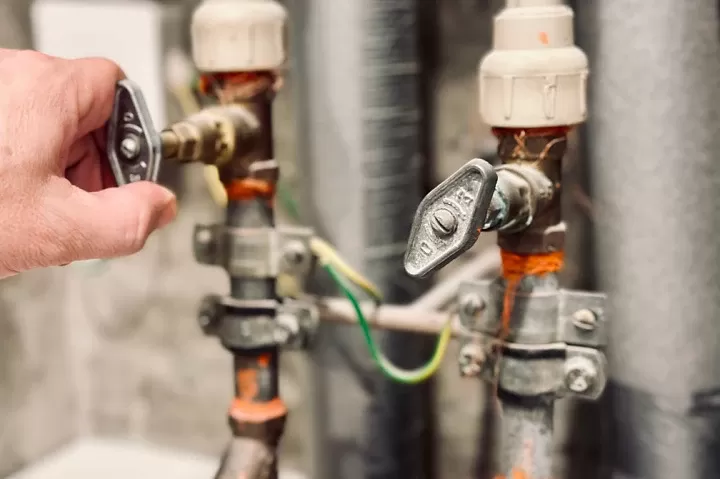
I’ve been to countless service calls that started with a homeowner just wanting to upgrade to a rainfall shower head and ended with them staring at a hole in their drywall.
It happens all the time. You go to unscrew the old head, and it feels like it’s been welded on.
Here is the reality: It’s usually not rust holding it on; it’s mineral deposits. Over the years, calcium and magnesium in your water harden into "scale," effectively gluing the metal threads together.
If you just grab a wrench and crank on it with all your might, you are going to break something and it likely won't be the shower head.
Here is the straightforward, professional way to get that stuck shower head moving again without snapping your pipes.
What You’ll Need
Before you start fighting the fixture, gather these supplies. You probably have most of them under the sink.
- White vinegar
- A sandwich bag (or quart-sized Ziploc)
- A heavy rubber band or zip tie
- Two wrenches (Adjustable crescent wrenches or Channel Locks)
- A thick rag or electrical tape
- A stiff brush (old toothbrush or wire brush)
- Teflon tape (Plumber’s tape)
Phase 1: The "Chemical" Approach (Try This First)
I always tell apprentices: Work smarter, not harder. Before we start applying torque, let’s try to dissolve the glue holding the shower head in place.
- Bag it up: Fill your plastic bag about halfway with standard white vinegar. The acidity in the vinegar eats away at calcium carbonate (the white crusty stuff).
- Submerge: Lift the bag up over the shower head so the nozzle and the connection nut are fully submerged in the vinegar.
- Secure it: Use the rubber band or zip tie to strap the bag to the shower arm (the pipe coming out of the wall).
- Wait: This isn't an instant fix. Let it soak for at least 2 to 4 hours. If you can leave it overnight, even better.
- The Test: Remove the bag and wipe it down. Wrap a rag around the head for grip and try to turn it counter-clockwise by hand.
If it spins, you just saved yourself a lot of elbow grease. If it’s still stuck, move to Phase 2.
Phase 2: The Manual Approach (The "Two Wrench" Method)
This is where most DIYers make a critical mistake. They grab one wrench, clamp it on the stuck head, and pull.
Do not do this.
The pipe coming out of your wall (the shower arm) is screwed into a fitting inside the wall called a "drop ear elbow." If you twist the shower arm too hard, you can snap that fitting or break the solder joint inside the wall. That turns a 10-minute job into a full tile-and-drywall demolition project.
Here is the Pro Secret: You must use two wrenches.
- Protect the Chrome: Wrap a thick rubber band, electrical tape, or a rag around the shower arm and the connector nut. Most shower heads are just chrome-plated plastic or brass; jagged plier teeth will chew them up instantly.
- The Anchor: Take your first wrench (or locking pliers) and clamp it onto the shower arm (the pipe). Hold this wrench steady. Its only job is to prevent the pipe from spinning.
- The Turner: Take your second wrench and clamp it onto the flat distinct sides of the shower head nut.
- Apply Torque: While holding the shower arm wrench perfectly still, turn the shower head wrench counter-clockwise (lefty-loosey).
- Steady Pressure: Don't jerk or hammer the wrench. Apply firm, steadily increasing pressure until you feel the seal break.
Phase 3: The Last Resort (Heat & Penetrating Oil)
If you’ve soaked it and wrenched it, and it still feels solid as a rock, we need to get aggressive.
Step A: Penetrating Oil
Standard WD-40 is a water displacer, not a great penetrant. If you have it, use something like PB Blaster or Liquid Wrench.
- Spray the oil right where the threads of the head meet the arm.
- Let it sit for 15 to 20 minutes.
- Wipe off the excess (it's slippery) and try the Two Wrench Method again.
Step B: The Hair Dryer Trick
Metal expands when it gets hot. We want to expand the nut slightly to break the mineral bond.
- Do NOT use a blowtorch. You will melt the plastic washers inside or scorch the finish.
- Use a hair dryer on the highest heat setting. Aim it directly at the threaded connection nut for a few minutes.
- Once it’s hot to the touch, drape your rag over it (don't burn your hand) and try the wrenches again immediately while the metal is expanded.
The Finish Line: Prep for the New Head
Congratulations, you got the old one off! But don't just screw the new one on yet, or you’ll be dealing with leaks next week.
- Clean the Threads: Look at the threads on the wall pipe. They are probably covered in old white tape and crusty minerals. Use a wire brush or an old toothbrush to scrub them clean.
- Teflon Tape is Non-Negotiable: You need fresh plumber's tape (thread seal tape).
- Pro Tip: Wrap the tape clockwise (in the same direction you screw the head on). If you wrap it backward, the tape will unravel and bunch up when you install the new head. Go around the threads 3 or 4 times.
- Hand Tighten Only: Screw the new shower head on by hand. Once it stops turning, give it maybe a quarter-turn more. Do not crank it down with a wrench. Over-tightening crushes the rubber washer inside and causes leaks.
Final Thoughts
Plumbing is mostly about patience and leverage. If it feels like you're forcing it too hard, stop, take a breath, and add more vinegar or oil. It’s always cheaper to wait an hour for the vinegar to work than it is to call me to fix a broken pipe in your wall!